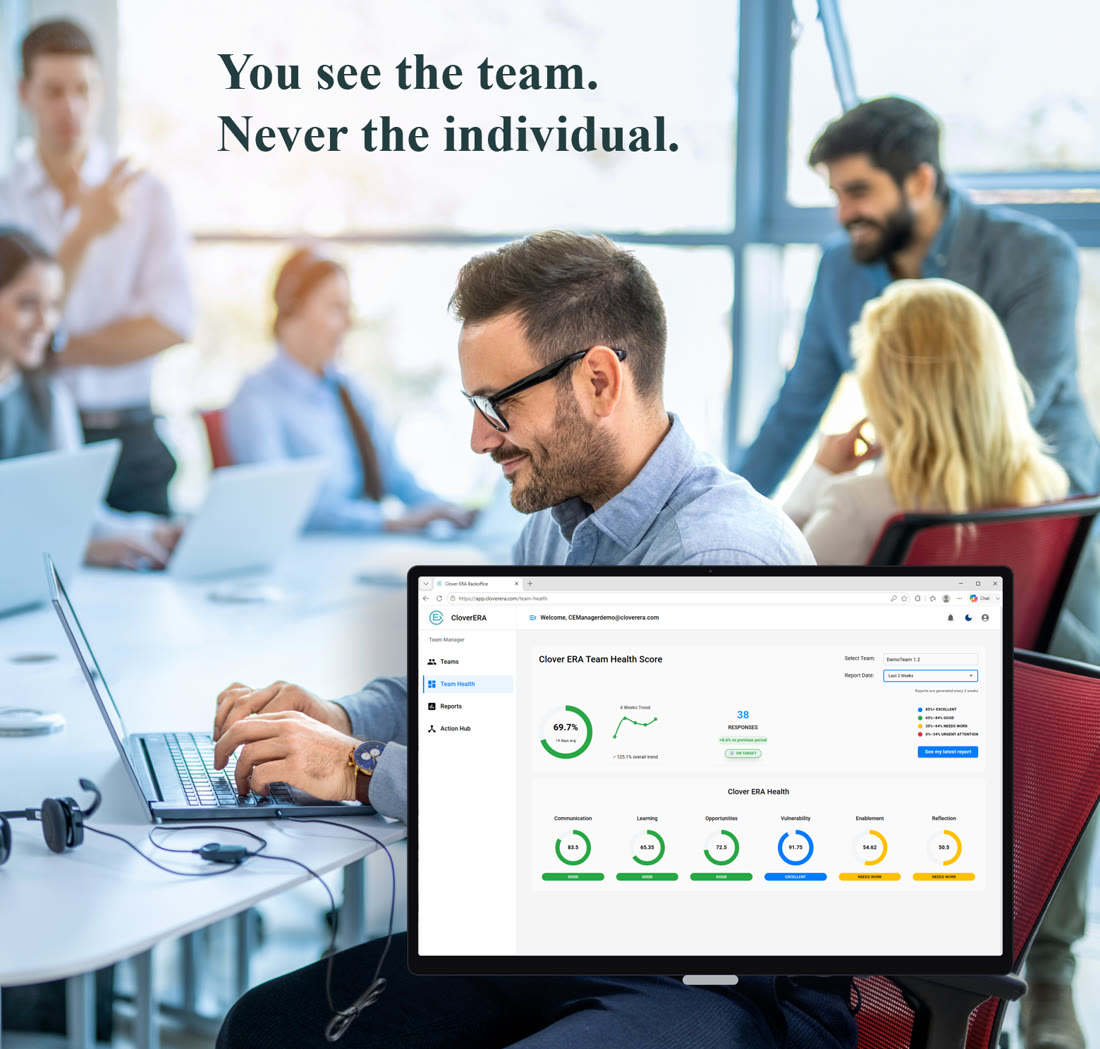
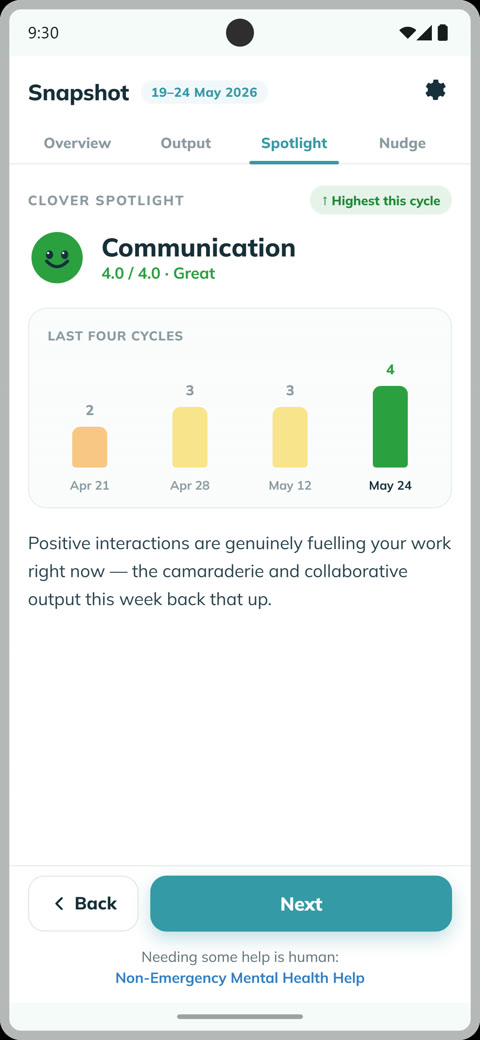
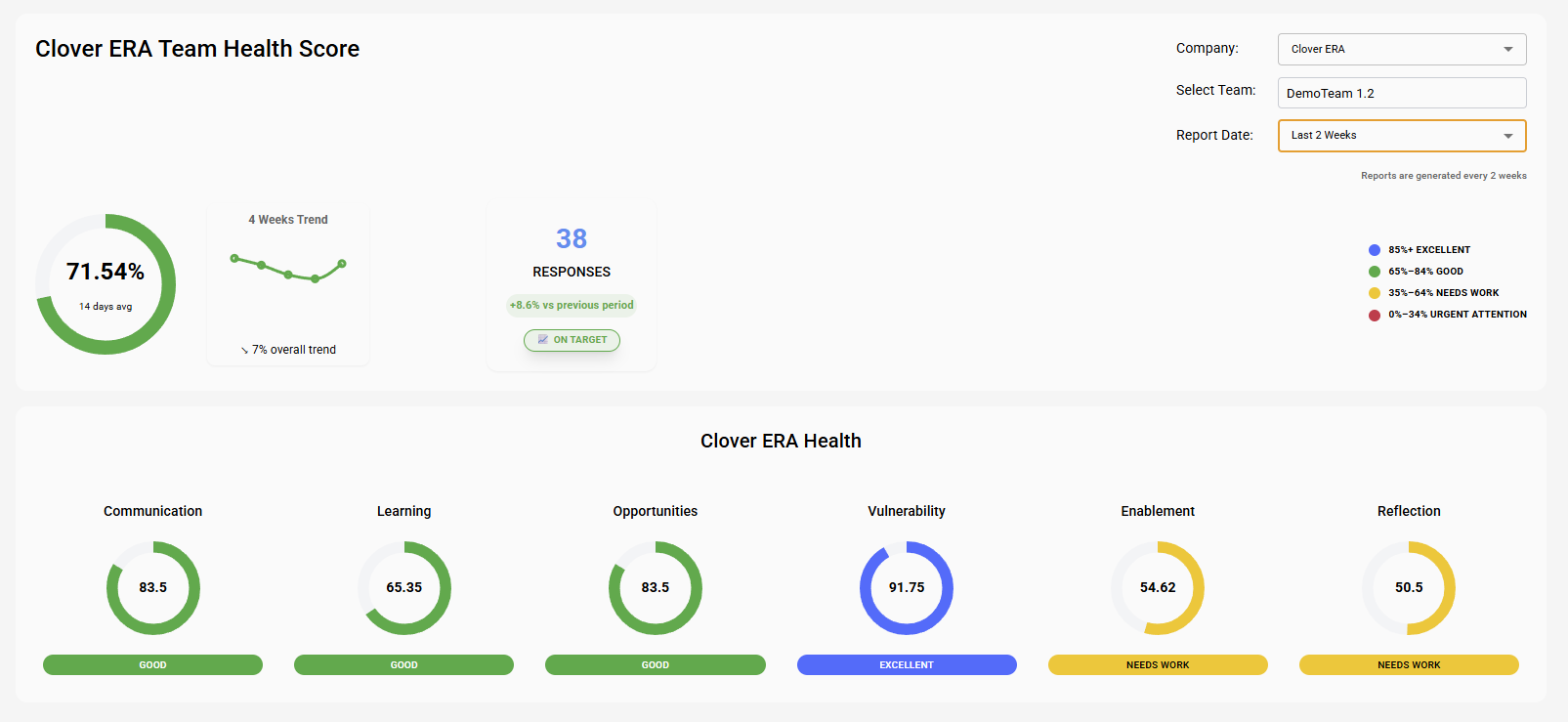
Six dimensions of team performance, scored individually so you see exactly where to focus.
See the dimensions explained›Managers give yourself the unfair advantage.
Every manager can now see, what the best managers have always sensed and know exactly what to do about it.
The signals that actually determine team performance show up in the conversations your team has after the meeting, in the questions they stop asking, in the contributions that get quieter. These have been invisible to managers because HR tools have been designed to measure something else.
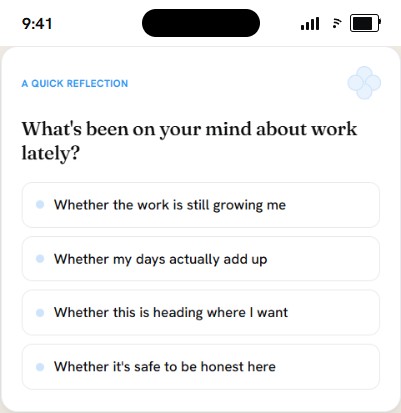
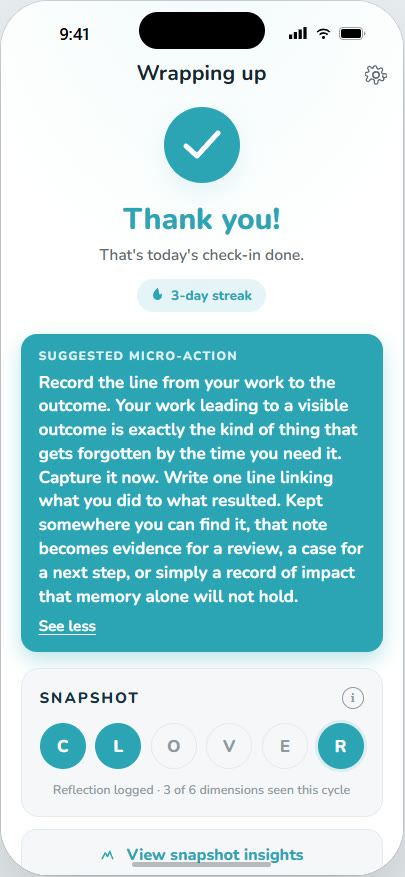
Clover ERA is the manager's analyst and coach. Your team's daily 30-second check-ins surface underlying themes and signals. The platform translates this into specific micro-actions that compound incrementally.
Or scroll to see what your bi-weekly report looks like.
Three windows into what your team's data looks like.
-
Opportunity Mapping (40 min)
Responds to a score of 38.25 on Opportunities — 31.75 points below target. Externalises growth paths so people can see them without raising their hand first.
-
Before your next team meeting…
Write down one growth-related move a team member made recently and name it out loud at the start of the meeting. Counters the signal that ambition reads as disloyalty.
The platform routes the specific worksheet or micro-action calibrated to your team's current state, every two weeks.
See the methodology library›Before your next team meeting, write down one growth-related move a team member has made recently, however small, and name it out loud at the start. read more…
Every recommendation becomes a tracked action with status, ownership, and completion visibility.
See what the Hub tracks›Your analyst and coach has a library of 56 guided sessions. Each one is already designed for you.
Most engagement platforms tell you what is wrong. Clover ERA gives you the guided session to address it. The library has 56 worksheets across the six CLOVER dimensions, each one a complete operational playbook. Neuroscience grounding. Phase-by-phase exercises with timing. The exact language to use including the difficult moments. Facilitation notes for situations that arise. Signals that confirm the intervention is working.
Your analyst and coach identifies which guided session your team needs and when. You receive the complete operational methodology. Your job is execution, not design. The platform routes one session per two-week cycle, never more. The library is depth, not workload.
56 worksheets total · New worksheets added quarterly based on patterns the cohort is encountering.
C3Transparency Workshop
Why this works
Information asymmetry triggers the brain's threat detection system. When people sense that information is being withheld (even unintentionally), the amygdala interprets this as a social threat: "What don't I know? Am I being excluded? Is something happening that affects me?" This drives cortisol and suspicion, eroding trust even when no deception exists.
Transparency reverses this. When information flows openly, cortisol drops and oxytocin rises. The brain shifts from threat-scanning to collaborative processing. Critically, the brain responds to the act of sharing as much as the content: the signal "I trust you with this information" is itself a trust-building mechanism.
The exercise
Phase 1 — Anonymous Concern Collection8 minutes
Collect anonymously (cards shuffled, or Mentimeter). Read each one aloud. Group into themes on the flipchart.
Phase 2 — Categorise the Gaps10 minutes
For each theme, the team categorises:
- "I can share this now" — information the manager has and can provide immediately
- "I can share this with context" — information that exists but needs framing or timing
- "I genuinely don't have this" — information the manager also lacks
- "I can't share this and here's why" — confidential or premature information with a transparent explanation of why it can't be shared
The fourth category is critical. "I can't tell you" with no explanation destroys trust. "I can't share details about this yet because negotiations are ongoing, but I will update you by [date]" builds it. Transparency is not about sharing everything. It is about being honest about what you can and cannot share, and why.
The full worksheet continues with two more phases (Manager Transparency Commitment and Team-to-Team Transparency), facilitation notes for difficult situations, the signals that confirm the intervention is working, and the cross-pillar connections to other worksheets. Each of the 56 worksheets has the same depth. Available to platform customers.
Want substantive proof of the library beyond this preview? Explore the methodology page›
Between guided sessions, the library has over 2,000 micro-actions calibrated to fit into existing manager touchpoints. A reflection question added to the close of a 1:1. A standing item at the start of a team meeting. A specific message sent to a team member. Each micro-action takes 2–5 minutes. The platform surfaces the two or three calibrated to your team's current state every two weeks. The library exists so the platform always has the right one to route. You never see all 2,000.
-
"What's one thing from this week you'd do differently, and what's one thing you'd repeat?"
-
Name the psychological safety gap directly. "I've heard that some feedback hasn't felt safe to give. I want to change that."
-
Add a career conversation segment to every 1:1. Start with: "What does the next year look like for you?"
The platform routes the right intervention to the right manager every two weeks. Your job is execution, not design.
Three real reports. Three completely different patterns.
These are real outputs from teams running on the platform. Each shows the same structure: what the team's manager believed before the data came in, what the platform surfaced, what the platform routed in response. Three different teams. Three different discoveries. Each one with a specific intervention designed for the specific dysfunction.
-
Actual platform output · Example 01 of 03
The team lead believed this person was self-sufficient and quietly competent.
The platform surfaced the same language as withdrawal. One respondent answered the Voice question with "I just stay in my lane and do my work." In a 1-on-1 that sentence reads as competence. On the Voice question it reads as someone who has stopped trying to be heard.
The platform routed re-engagement before withdrawal becomes resignation: name the psychological safety gap directly, build structured non-task time into 1:1s, and run the V1 Vulnerability Circle to rebuild the conditions for honest input.
-
Actual platform output · Example 02 of 03
Leadership had already addressed vulnerability. The prior report flagged it and recommended direct action.
The conditions kept declining anyway. Vulnerability dropped from 43 to 38. Two respondents independently called interactions "superficial or task-focused only." Learning looked strong. The relational layer was eroding underneath the metrics that looked fine.
The platform routed methodology rather than another conversation: the V1 Vulnerability Circle worksheet plus protected non-task time in 1:1s.
-
Actual platform output · Example 03 of 03
Leadership expected to find motivation problems. Engagement initiatives, burnout interventions, perhaps a wellness rollout.
The platform surfaced design failures. Reflection had the highest response count and the weakest positive rate (14.8%) because workload had consumed the headspace it requires. Career pathways scored 24.7 points below threshold because conversations happen annually, not continuously. One respondent described applying internally as "would be seen as betraying my manager." This was not motivation. It was structural.
The platform routed structural redesign rather than initiatives: build reflection into existing 1:1 touchpoints (a single closing question), and make career conversations a standing ten-minute segment of every 1:1 plus the OP1 Roadmap worksheet for individual sessions.
Three teams. Three discoveries leadership would not have made through the existing dashboards. This is what you get every two weeks for every team you measure.
The dashboards show the actions. The Action Hub tracks what gets done.
Every Action Step on a bi-weekly report ends with a Create Action button. When you create an action, it lands in the Action Hub. The Action Hub is the live record of every recommendation that became a commitment, every commitment you have worked on, and every signal you have addressed.
Filter by the teams you look after. See what's been initiated, what's in progress, what's complete. The Action Hub turns one-time recommendations into a measurable behaviour over time.
Micro-actions and mini-actions that fit into your working day. A five-minute conversation. A quick message to the team. A worksheet session that takes thirty minutes but resolves three months of friction. You don't need to become a different manager. You just need visibility into what's actually happening, and a clear next step that gets tracked.
Adopt on your team this week. No HR mandate. No IT lift.
Most engagement platforms hold employee data on their servers. Adopting them requires HR sign-off, IT integration, and an enterprise security review. Clover ERA's anonymity is structural, not procedural.
Individual employee data stays on the device. There are no device IDs. The connection to your team runs through a setup code your team members enter once. The platform itself does not have the identifiers that would let it re-identify individuals. The company sees aggregated team data because that is the only data the platform has.
You do not need IT involvement. You do not need HR sponsorship. You can run the platform on your team this week. The 21-day free trial does not require enterprise procurement.
No device IDs. No server-side personal data. Code-based association. The architecture itself is the operational permission to adopt.
Across the cohort, the average employee answers a CLOVER question four times per week. For a five-day work week, that is 80 percent participation. Voluntarily. Without mandate. The architecture works because employees use the app for their own benefit; the data flows up through the anonymity layer.
Meg runs project management at a 350-person manufacturing company. This is what changed in ten weeks.
Director, Project Management · Manufacturing Company · Anonymised
Project management team of seven. Surface metrics looked acceptable but Meg sensed something was off. Specific concerns about psychological safety after one team member had pushed back hard against a colleague months earlier. Career conversations happening once or twice a year. Meg described the team as functioning but not thriving.
The platform surfaced specific patterns. Three respondents independently chose the same phrase: "career conversations happen once or twice a year and feel empty." One team member's response to the Voice question was "I just stay in my lane and do my work." The platform routed the V1 Vulnerability Circle worksheet plus a structured 10-minute career segment in every 1:1 plus the OP1 Roadmap to Personal Greatness worksheet for individual sessions.
Meg's boss noticed the difference unprompted. He met with the team and reported back: "Where in the past it's been negative, now everybody actually had something to share. It seemed more positive. More collaborative than what I've seen in the past."
Meg's experience is one team's pattern. Other teams will produce different patterns. What is consistent across the cohort is that the platform surfaces specific signals leadership would not see otherwise and routes specific methodology to address them.
Start with one team. $295 a month.
The Single Team tier is $295 a month for up to 20 people. It includes the daily check-in, the bi-weekly report, the Action Hub, the full methodology library (all 56 worksheets and 2,340 micro-actions), the manager dashboard, and the personal app for every team member. The 21-day free trial is included.
- Full methodology library
- Manager dashboard
- Bi-weekly reports + Action Hub
- 21-day free trial
- Full methodology library
- Leadership dashboard
- Cross-team pattern visibility
- 21-day free trial
Every tier includes the full methodology library. 56 worksheets across the six CLOVER dimensions. 2,340 micro-actions routed every two weeks. The methodology is not gated by tier; what scales with tier is the number of teams measured.
See all pricing tiers (up to 25+ teams)
If you have tried surveys before, this is not another one.
-
What surveys produce
Surveys produce dashboards. You read the dashboard, decide what it means, design an intervention, build the materials, run the intervention, and hope it worked. The cognitive load sits with you. Most managers drop the loop somewhere between "design an intervention" and "build the materials."
-
What Clover ERA produces
Clover ERA gives you a virtual coach. The platform measures what is happening on your team, identifies what to attend to, selects the relevant guided session from the library, and hands you the complete playbook with the language to use. The cognitive load sits with the platform. Your job is execution.
-
In your week
A 30-minute team session running V1 Vulnerability Circle. A two-minute closing question added to your standing 1:1s. A specific message you send to a team member who has been quiet. One guided session per two-week cycle, never more. Methodology, not advice. Execution, not design.
The methodology is the asset. The measurement is how the platform routes you to the right piece of it at the right time.
Run the platform on your team for 21 days. No credit card. No sales call.
If the platform surfaces something you would not have seen otherwise, you have your answer. If it does not, walk away. The trial is sized to be the smallest possible commitment that lets you evaluate honestly.
Want to talk to someone first? Schedule a 15-minute Cohort Conversation› The conversation is calibrated to managers running the platform on their own teams as much as to enterprise rollouts.
Want to see the methodology library in full first? Explore the methodology page›
Clover ERA